

India’s relationship with gold is centuries old. It sits in household lockers, moves through generations as inheritance, and quietly functions as a financial safety net during uncertain times. But for all its cultural weight, the way most Indians buy and hold gold has remained stubbornly inefficient, burdened by making charges, purity ambiguity, storage costs, and an informal pricing ecosystem that rarely works in the retail investor’s favour.
On May 4, 2026, the National Stock Exchange of India launched Electronic Gold Receipts as a new trading segment, aimed at bridging the gap between physical gold and financial markets through a regulated and secure platform. For retail investors, jewellers, traders, and institutions alike, it marks a meaningful shift in how gold can be owned and traded in India.
What Are Electronic Gold Receipts?
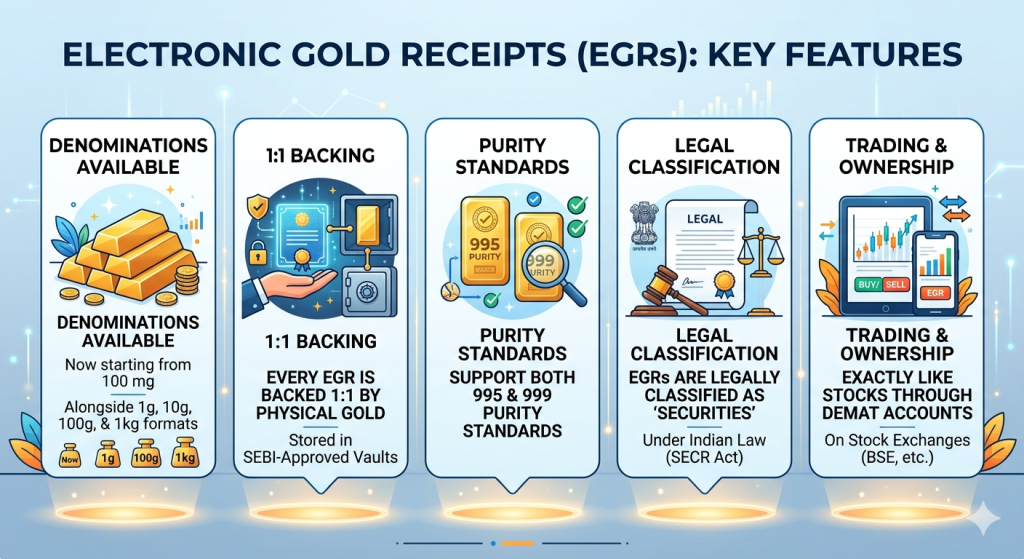
Electronic Gold Receipts (EGRs) represent ownership of physical gold as dematerialised securities. SEBI-accredited vaults store the gold, while investors hold the receipts in their demat accounts. Physical gold fully backs each EGR, ensuring a direct link between its value and the underlying metal.
A SEBI-approved vault manager accepts the gold deposit, converts it into electronic receipts, and credits them to the investor’s demat account.
It is also worth noting that EGRs were first launched by BSE in 2022 during Muhurat Trading on Diwali. NSE’s 2026 launch significantly expands the regulated exchange infrastructure available for EGR trading.
How Electronic Gold Receipts Work
The EGR framework operates through a structured chain involving vault managers, depositories, and the exchange itself.
It begins with a gold deposit. An investor or institution deposits physical gold with a SEBI-accredited vault manager. A vault manager assesses the gold for purity and weight, and it must meet either 995 or 999 fineness standards as prescribed by BIS and LBMA. Once verified, the vault manager converts the gold into electronic receipts and credits them to the investor’s demat account held with NSDL or CDSL. At this point, the EGRs are live and tradeable on NSE.
Trading works exactly like equity. Investors search for the EGR symbol on NSE and place buy or sell orders through their broker’s platform. Trading runs Monday to Friday between 9:00 AM and 11:30 PM. The market determines prices in real time, and NSE’s clearing corporation settles all transactions.
Redemption is straightforward. Investors can request physical delivery at any time. The investor must initiate the request between 10:00 AM and 3:00 PM, and it remains valid for 3 days, with the vault manager processing it on the same working day. Once the vault manager processes the request, it extinguishes the corresponding EGR and withdraws the physical gold from the vault.
The entire lifecycle, from deposit, dematerialisation, trading, to redemption, stays within a regulated framework.
Key Features of Electronic Gold Receipts
- Dematerialised and demat-held: EGRs are stored in the investor’s NSDL or CDSL demat account alongside equities and bonds in a single portfolio view.
- Standardized purity: The gold underlying EGRs must meet standards prescribed by the London Bullion Market Association (LBMA) and the Bureau of Indian Standards (BIS). Gold of standardised 995 and 999 purity backs all EGRs.
- Wide denomination range: EGRs are available across denominations including 1 kg, 100 g, 10 g, 1 g, and 100 mg, in both 999 and 995 purity variants.
- Extended trading hours: EGRs trade Monday to Friday between 9:00 AM and 11:30 PM.
- Physical redemption: Investors can redeem their EGRs by requesting physical delivery. The investor must initiate the request between 10:00 AM and 3:00 PM, and it remains valid for 3 days, with the vault manager processing it on the same working day. The vault manager extinguishes the corresponding EGR and withdraws the physical gold from the vault.
- Broad participant access: The segment is open to jewellers, refiners, traders, and institutional investors, in addition to retail participants.
- Regulated ecosystem: EGRs operate within a framework involving SEBI, NSE, NSDL, and vault managers, with investor protection built in throughout.
Benefits of Electronic Gold Receipts
- Cost efficiency: Physical gold, particularly jewellery, carries making charges and retail markups. EGRs eliminate making charges and wastage costs, and operate under market regulators offering greater price transparency. Investors pay standard brokerage and exchange transaction charges at the point of trade.
- Liquidity: EGRs can be traded anytime during market hours, offering better liquidity compared to physical gold, with prices determined through exchange-based demand and supply.
- No storage burden: EGR investors do not need to worry about purity or incur the cost of a bank locker, and the risk of storing physical gold at home is removed entirely.
- Accessibility: NSE EGRs can be bought in very small denominations, even 100 milligrams — making gold investment genuinely accessible at modest ticket sizes.
- Future potential: EGRs could deepen India’s organised bullion market and may, in the future, enable instant digital gold loans through electronic marking of lien. Regulators and market experts also expect EGRs to reduce regional price differences in gold across India.
For investors building diversified portfolios, professional investment advisory services increasingly recognise EGRs as a structurally sound vehicle for gold allocation, sitting between the flexibility of ETFs and the tangibility of physical gold. That positioning becomes clearer when we place EGRs alongside the alternatives.
| Feature | Physical Gold | Gold ETFs | Sovereign Gold Bonds | Electronic Gold Receipts |
| Storage Risk | High | None | None | None |
| Convertible to Physical Gold | Yes | No | No | Yes |
| Exchange Traded | No | Yes | Limited | Yes |
| Purity Guaranteed | Varies | Yes | Yes | Yes (LBMA & BIS) |
| Minimum Denomination | High | ~1 unit | 1 gram | 100 milligrams |
| Interest Income | No | No | 2.5% p.a. | No |
| Demat Account Required | No | Yes | Yes | Yes |
Taxation of Electronic Gold Receipts
The government taxes Electronic Gold Receipts as physical gold. Gains made within 24 months of purchase attract Short-Term Capital Gains tax, and the investor’s applicable income slab rate determines the tax liability. Holdings beyond 24 months attract Long-Term Capital Gains tax at a flat 12.5%, with no indexation benefit, a change introduced in Budget 2024 that investors with longer time horizons should factor into their planning.
| Holding Period | Gain Type | Tax Treatment |
| Less than 24 months | Short-Term Capital Gain (STCG) | Taxed at applicable income slab rate |
| More than 24 months | Long-Term Capital Gain (LTCG) | 12.5% flat |
Redeeming an EGR for physical gold delivery does not constitute a taxable transfer under the Income Tax Act, the holding period and cost basis simply carry forward from the original acquisition date. STT applies on exchange transactions at government-prescribed rates, and GST, while absent on the exchange trade itself, may apply on physical redemption along with any associated delivery or handling charges.
For investors holding gold across multiple instruments, the removal of indexation benefit in Budget 2024 changes the long-term tax math in ways that aren’t always immediately obvious. A financial consultant can help work through the numbers before the investor makes any reallocation.
Risks and Considerations
EGRs launched just over a week ago. Market depth is still developing, and investors should factor that in.
In the initial phase, high bid-ask spreads could impose a less visible cost. Limited trade volumes may lead to wider spreads and reduced pricing efficiency, though market participants expect EGRs to become more cost-efficient as liquidity improves.
EGRs carry no expense ratio like a mutual fund would, but they are not cost-free. Investors should account for the full charge structure before entering the market:
- Brokerage fees apply on every buy and sell transaction, at rates set by the broker.
- Exchange transaction charges are levied by NSE on each trade.
- STT (Securities Transaction Tax) applies on exchange transactions at government-prescribed rates.
- Demat account charges include annual maintenance fees charged by the depository participant.
- Vaulting charges are ongoing fees for storing the physical gold in the accredited vault.
- Delivery and handling charges apply if the investor opts to redeem EGRs for physical gold, and GST may apply on that redemption as well.
Taken together, these costs can add up meaningfully, particularly for smaller investments or frequent traders. Investors should run the numbers against alternatives like Gold ETFs before committing, since ETFs consolidate most of these costs into a single expense ratio that is often easier to compare. A financial consultant can help benchmark these objectively.
Where EGRs Fit in Your Portfolio
For long-term, buy-and-hold investors, Sovereign Gold Bonds remain the stronger option as the 2.5% annual interest and tax-free maturity gain after eight years are difficult to match on a risk-adjusted basis. Gold ETFs suit investors who want price exposure with minimal friction and no intent to take physical delivery.
EGRs sit between physical gold and ETFs, combining the tangibility of physical ownership with the ease of a financial instrument. That specific combination of exchange liquidity and physical redeemability within a SEBI-regulated framework is what distinguishes EGRs from every other gold product currently available in the Indian market.
Conclusion
NSE’s launch of Electronic Gold Receipts aims to create a robust and transparent ecosystem for gold trading, enabling efficient price discovery, improved market participation, and enhanced trust across stakeholders including jewellers, refiners, and traders.
For investors who treat gold as an asset class, EGRs offer a regulated, cost-transparent, and physically redeemable route into the market. The infrastructure is live, SEBI has established the regulatory framework, and the government has clarified the tax treatment. What follows now is market participation catching up, which, given India’s appetite for gold, is likely a matter of when rather than if.
Before making any changes to an existing gold allocation, speaking with a financial consultant ensures the decision accounts for individual tax position, portfolio context, and investment horizon, not just the appeal of a new instrument.
Frequently Asked Questions (FAQs)
What accounts are needed for EGR investing?
A trading and demat account with a broker that offers EGR trading is required. Investors search for the EGR symbol and place orders on NSE.
Can EGRs be redeemed for physical gold?
Yes. Investors can request physical delivery, with the request valid for 3 days and processed between 10:00 AM and 3:00 PM on working days. The corresponding EGR is extinguished and physical gold is withdrawn from the vault.
How are EGRs different from app-based digital gold?
App-based digital gold operates outside the exchange and formal SEBI regulatory structure. EGRs are listed on a recognised stock exchange, subject to the same regulatory standards as other formally listed securities, under full SEBI oversight.
Is there a lock-in period in EGRs?
No. Unlike Sovereign Gold Bonds, which carry an 8-year maturity period and limited secondary market liquidity, EGRs have no lock-in. They can be sold on the exchange at any point during market hours.
What happens to my EGR if the vault shuts down or faces a dispute?
The gold is held in SEBI-accredited vaults that are subject to regular audits and regulatory oversight. The physical gold backing each EGR is ring-fenced from the vault manager’s own assets, which means it cannot be used to settle the vault’s liabilities. Investors retain ownership of the underlying gold regardless of what happens to the vault operator.
Disclaimer: This article is for informational purposes only and does not constitute financial advice. Information on EGRs, taxation, and regulatory frameworks is based on publicly available sources current as of May 2026 and may be subject to change. Readers are advised to consult a registered financial consultant or tax advisor before making any investment decisions. Past performance of gold as an asset class is not indicative of future returns.