
Achieving Financial Independence is no longer a dream reserved for high-income professionals or business owners. In India, rising salaries, digital investment platforms, and greater financial awareness have made early financial freedom more achievable than ever.
Financial Independence means having enough passive income or investments to cover your living expenses without depending entirely on a salary. It gives you freedom — freedom to choose your work, travel, spend time with family, or retire early.
The FIRE movement (Financial Independence, Retire Early) has gained popularity globally and is rapidly growing in Indian metro cities like Bengaluru, Mumbai, Hyderabad, Pune, and Delhi NCR.
What Is Financial Independence?
Financial Independence (FI) means your investments, savings, and passive income generate enough money to pay for your lifestyle indefinitely.
Simple Definition
If your annual expenses are ₹12 lakh and your investments generate ₹12 lakh per year consistently, you are financially independent.
Key Characteristics of Financial Independence
- No dependence on monthly salary
- Strong emergency fund
- Consistent investment income
- Minimal or zero debt
- Freedom to choose work instead of needing work
Why Financial Independence Matters in India
India’s economic environment makes Financial Independence increasingly important.
Rising Costs of Living
Major Indian cities have seen significant increases in:
- Rent
- Healthcare
- Education
- Fuel
- Lifestyle expenses
Lack of Universal Retirement Security
Unlike many Western countries, India does not provide broad government-backed retirement income for everyone. Most individuals must build their own retirement corpus.
Inflation Reduces Purchasing Power
India’s average long-term inflation rate typically ranges between 5% and 7%.
That means:
- ₹1 crore today may not hold the same value after 20 years
- Cash savings alone are not enough
- Investing becomes essential
The Core Principles of Early Financial Independence
1. Spend Less Than You Earn
This is the foundation of FI.
People chasing Financial Independence often maintain savings rates between 30% and 60% of their income.
2. Increase Income Aggressively
Your savings rate matters more than your salary alone.
Ways to increase income:
- Freelancing
- Side businesses
- Consulting
- Skill upgrades
- Remote global jobs
3. Invest Consistently
Wealth compounds over time.
The earlier you start investing, the easier FI becomes.
4. Avoid Lifestyle Inflation
Many professionals increase spending whenever income rises.
Instead:
- Upgrade investments first
- Upgrade lifestyle slowly
How Much Money Do You Need to Become Financially Independent?
A common FI formula is:
The 25x Rule
You need approximately 25 times your annual expenses invested.
For example:
| Annual Expenses | FI Target Corpus |
|---|---|
| ₹6 lakh | ₹1.5 crore |
| ₹12 lakh | ₹3 crore |
| ₹20 lakh | ₹5 crore |
This rule is based on the widely known 4% withdrawal strategy.
Important Indian Context
In India, you should also consider:
- Inflation
- Medical emergencies
- Family responsibilities
- Education costs
- Dependent parents
A conservative approach often works better.
Step-by-Step Plan to Achieve Financial Independence Early
Step 1: Calculate Your Current Expenses
Track:
- Fixed expenses
- EMI payments
- Insurance premiums
- Lifestyle spending
- Annual travel costs
Use budgeting apps like:
- ET Money
- Walnut
- INDmoney
- Moneycontrol
Step 2: Build an Emergency Fund
Keep 6–12 months of expenses in:
- Savings account
- Liquid mutual funds
- Fixed deposits
This prevents debt during emergencies.
Step 3: Eliminate High-Interest Debt
Prioritize repaying:
- Credit card debt
- Personal loans
- Consumer EMIs
Debt reduces investment capacity and slows wealth creation.
Step 4: Increase Your Savings Rate
Target savings milestones:
| Income Level | Ideal Savings Rate |
|---|---|
| Beginner | 20% |
| Intermediate | 35% |
| Aggressive FI | 50%+ |
Step 5: Invest in Growth Assets
Best Long-Term Investments in India
| Investment Type | Risk | Expected Long-Term Returns |
|---|---|---|
| Equity Mutual Funds | High | 10–14% |
| Index Funds | Moderate | 10–12% |
| PPF | Low | 7–8% |
| EPF | Low | 8%+ |
| Direct Equity | High | Variable |
| REITs | Moderate | 7–10% |
| NPS | Moderate | 8–12% |
Why Equity Matters
Historically, equity has outperformed inflation over long periods.
For young investors, equity allocation becomes critical for early FI.
Step 6: Create Multiple Income Streams
Financial Independence becomes easier when income is diversified.
Popular Passive Income Sources
- Dividend stocks
- Rental income
- YouTube channels
- Blogging
- Digital products
- Online courses
- Affiliate marketing
Step 7: Protect Your Wealth
Many people ignore risk management.
Essential protections include:
- Health insurance
- Term insurance
- Emergency liquidity
- Estate planning
Best Investment Options in India for FI
Equity Mutual Funds
Ideal for long-term wealth creation.
Advantages
- Professional management
- SIP investing
- Tax efficiency
- Compounding benefits
Best For
- Salaried professionals
- Beginners
- Long-term investors
Index Funds
Low-cost funds tracking indices like Nifty 50 or Sensex.
Why They’re Popular
- Lower expense ratios
- Simple strategy
- Consistent performance
Real Estate
Real estate can provide rental income and appreciation.
Pros
- Tangible asset
- Passive income potential
Cons
- Illiquid
- High maintenance
- Large capital requirement
Public Provident Fund (PPF)
Excellent for conservative investors.
Key Benefits
- Tax-free returns
- Government-backed safety
- Long-term compounding
Role of a Financial Consultant and Financial Planner
Many people confuse these two roles.
| Feature | Financial Consultant | Financial Planner |
|---|---|---|
| Focus | Investments & wealth growth | Holistic financial strategy |
| Scope | Market advice | Budgeting, retirement, insurance, taxes |
| Ideal For | Experienced investors | Long-term life planning |
| Compensation | Commission/Fee | Fee-based or advisory |
When Should You Hire a Financial Planner?
Consider hiring one if:
- You have multiple investments
- You’re nearing retirement
- You want tax optimization
- You need estate planning
- You struggle with investment discipline
Benefits of Professional Guidance
A good financial consultant can help:
- Optimize portfolio allocation
- Reduce emotional investing
- Improve tax efficiency
- Build long-term wealth systems
Common Mistakes That Delay Financial Independence
1. Starting Too Late
Compounding rewards time more than high investment amounts.
Example
Starting SIPs at age 25 instead of 35 can create a dramatically larger corpus.
2. Ignoring Inflation
Keeping all savings in fixed deposits may not beat inflation.
3. Overspending on Lifestyle
Luxury purchases often delay FI significantly.
Common traps include:
- Expensive cars
- Frequent EMI purchases
- Premium gadgets
- Status-driven spending
4. Lack of Financial Education
People spend years earning money but little time learning wealth management.
5. No Clear Goal
Without measurable targets, FI becomes vague and difficult to achieve.
Financial Independence Strategies by Age Group
In Your 20s
Priorities
- Build investing habits
- Increase skills and income
- Take calculated career risks
Recommended Allocation
- 70–80% equity
- Aggressive SIPs
In Your 30s
Focus Areas
- Family financial planning
- Home purchase decisions
- Child education planning
Important Goal
Increase savings aggressively before lifestyle expenses rise further.
In Your 40s
Main Priorities
- Debt reduction
- Retirement corpus protection
- Asset diversification
Recommended Strategy
Shift gradually toward balanced portfolios.
Pros and Cons of Retiring Early
Pros
Freedom of Time
You control your schedule.
Reduced Stress
Financial pressure decreases significantly.
Career Flexibility
You can pursue passion projects or entrepreneurship.
Cons
Healthcare Costs
Medical inflation in India is rising rapidly.
Market Risks
Poor investment planning can affect long-term sustainability.
Social Adjustment
Some people struggle emotionally after early retirement.
Real-World Example of Financial Independence in India
Example Scenario
Rahul, a software engineer in Bengaluru:
- Started investing at age 24
- Invested ₹40,000 monthly through SIPs
- Increased SIPs by 10% annually
- Maintained a 45% savings rate
- Avoided unnecessary debt
By age 42, his portfolio crossed ₹4 crore.
His investments generated enough income to support his family without depending fully on a corporate salary.
Key Lessons
- Consistency matters more than timing
- Income growth accelerates FI
- Lifestyle discipline creates long-term freedom
FAQ
1. What is the ideal age to achieve Financial Independence in India?
Many FIRE followers target financial independence between ages 40 and 50, but the ideal age depends on lifestyle, income, and expenses.
2. How much money is enough for Financial Independence in India?
A common benchmark is 25–30 times your annual expenses, adjusted for inflation and healthcare costs.
3. Can middle-class Indians achieve Financial Independence?
Yes. Consistent investing, controlled expenses, and increasing income can help middle-class earners achieve FI over time.
4. Is SIP enough for Financial Independence?
SIPs in equity mutual funds can play a major role, but diversification across assets and income streams is recommended.
5. Should I hire a financial consultant?
If you lack investment knowledge, need tax planning, or want a structured retirement roadmap, a financial consultant can add value.
6. What is the biggest mistake people make while chasing FI?
Lifestyle inflation and delaying investments are among the most common mistakes.
7. Is Financial Independence the same as early retirement?
Not necessarily. Financial Independence gives you the option to retire early, but many people continue working by choice.
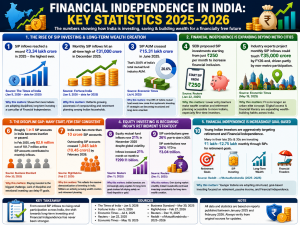
Below are some of the most relevant and high-impact statistics that explain the current state of Financial Independence, investing behavior, retirement preparedness, and wealth creation trends in India.