Imagine you lend ₹1,000 to a friend and they promise to pay you interest every year and return the full amount after a fixed period. Now, if someone else offers a similar deal but at a different price or interest rate, how do you decide which one is better?
This is exactly the situation investors face in the bond market. Bonds are simply loans given to governments or companies. In return, investors receive periodic interest and the principal at maturity. However, bonds often trade in the market at prices that are different from their original value, which makes it difficult to compare them using just the interest rate.
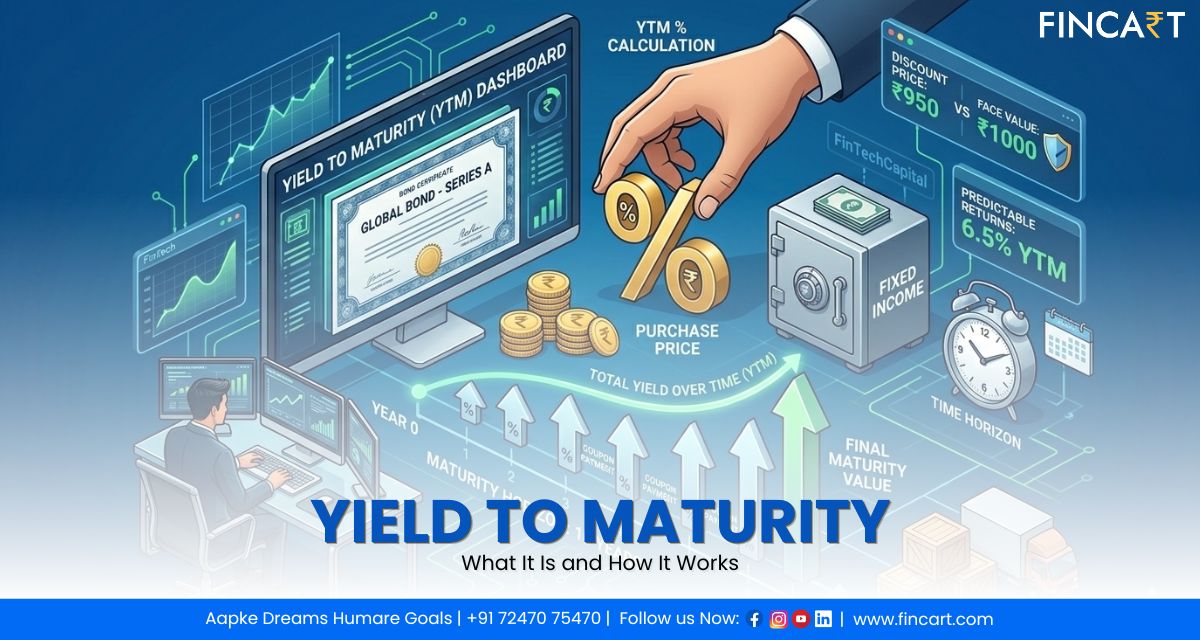
This is where yield to maturity becomes important. It helps investors understand the total return they can expect if they hold a bond until it matures. Instead of focusing only on the interest income, it captures the complete picture, including gains or losses due to price differences. For anyone investing in fixed income instruments or debt mutual funds, understanding yield to maturity is essential for making informed decisions.
What is Yield to Maturity?
Yield to maturity is the most comprehensive way to understand the return from a bond. Unlike the coupon rate, which only reflects the annual interest payment, it captures the total return an investor can expect over the entire holding period.
In formal terms, yield to maturity is defined as the internal rate of return (IRR) that equates the present value of all future cash flows (coupons and principal) to the bond’s current market price.
While this definition sounds technical, the concept becomes clearer when broken down.
A bond generates returns from two sources:
- Interest income: Regular coupon payments received during the holding period
- Capital gain or loss: The difference between the purchase price and the face value received at maturity
Since bonds often trade above or below their face value, looking only at the coupon rate gives an incomplete picture. This is where yield to maturity comes into play. It combines:
- All future interest payments
- The gain or loss at maturity
- The time remaining until maturity
and converts them into a single annual return figure. This makes comparison much more meaningful.
However, it is important to keep in mind that this measure assumes that the bond is held until maturity and all coupon payments are reinvested at the same rate. While these assumptions may not always hold in real market conditions, yield to maturity still remains one of the most widely used and practical measures of expected bond returns.
Why Yield to Maturity is Important
A common challenge in bond investing is that price and return do not always move together in an obvious way. For example:
- A bond bought at a discount increases overall return because of the additional gain at maturity.
- A bond bought at a premium reduces overall return despite paying the same interest.
As a result, two bonds with identical coupon rates can have very different returns depending on their market price. This is where yield to maturity becomes useful. It expresses the true earning potential of a bond in a single number, allowing investors to compare different options on a like-for-like basis.
In addition, it helps in practical decision-making:
- It allows comparison across bonds with different prices, tenures, and coupon structures
- It provides a forward-looking estimate of returns instead of relying only on past data
- It helps assess whether a bond is relatively attractive in current market conditions
In practice, a mutual fund advisor often uses yield to maturity as a screening tool while evaluating debt instruments and portfolios, along with other factors such as credit quality and duration.
Key Components of Yield to Maturity
To understand how yield to maturity works, you need to know the factors that influence it.
Face Value
Face value is the amount the bond issuer promises to repay at maturity. Most bonds in India have a face value of ₹1,000. This is the amount you will receive at the end, regardless of the price you paid.
Coupon Rate
The coupon rate is the fixed interest rate paid by the bond. If a bond has a face value of ₹1,000 and a coupon rate of 8 percent, you will receive ₹80 every year.
Market Price
Bonds are traded in the market, and their prices change based on interest rates and demand. You may buy a bond at a discount, such as ₹950, or at a premium, such as ₹1,050. This difference between market price and face value directly affects the yield to maturity.
Time to Maturity
This refers to the number of years remaining until the bond matures. A longer time horizon means more interest payments and greater impact on overall returns.
Reinvestment Assumption
Yield to maturity assumes that all interest payments are reinvested at the same rate. While this simplifies calculation, it may not always be realistic in changing market conditions.
These factors are combined to calculate yield to maturity using a time-based valuation approach
Formula of YTM
Yield to maturity can be estimated using the formula:
YTM = [ C + (FV − PV) ÷ t ] ÷ [ (FV + PV) ÷ 2 ]
Where:
- C = Annual coupon payment
- FV = Face value of the bond
- PV = Current market price (present value)
- t = Time to maturity (in years)
This formula provides a simplified way to understand how yield to maturity is derived without going into complex calculations.
The numerator represents the total annual return from the bond. It combines:
- The annual interest income (C)
- The annualised capital gain or loss, calculated as (FV − PV) ÷ t
The denominator represents the average investment value over the holding period. It takes the midpoint of the purchase price and the maturity value, calculated as (FV + PV) ÷ 2.
By dividing total annual return by average investment, the formula converts all cash flows into a single annual return percentage.
This structure explains how different factors influence yield:
- If the bond is purchased at a discount (PV < FV), the capital gain component increases the overall yield
- If the bond is purchased at a premium (PV > FV), the capital loss reduces the overall yield
- A higher coupon payment directly increases the yield
- A longer time to maturity spreads gains or losses over more years, reducing their annual impact
It is important to note that this is an approximation formula. The exact ytm is calculated using a present value approach and iterative methods. However, this version is widely used for building intuition and understanding how the different components interact.
Yield to Maturity vs Coupon Rate
Many investors confuse ytm with the coupon rate. While both relate to returns, they are fundamentally different.
| Feature | Yield to Maturity | Coupon Rate |
| Meaning | Total expected return | Fixed annual interest |
| Depends on | Market price and time | Face value only |
| Changes over time | Yes | No |
| Purpose | Investment decision-making | Income estimation |
While the coupon rate tells you how much interest you will receive each year, it does not consider the price at which you buy the bond. Yield to maturity, on the other hand, provides a complete return picture by including both interest income and price-related gains or losses. This is why investors should not rely only on coupon rates when comparing bonds.
Factors Affecting Yield to Maturity
Several factors influence the yield to maturity of a bond:
- Interest rates: When market interest rates rise, bond prices fall, which increases YTM. When rates fall, bond prices rise, reducing YTM
- Inflation expectations: Higher inflation reduces the real return from bonds, pushing yields higher
- Credit risk: Bonds issued by riskier entities offer higher yields to compensate investors
- Time to maturity: Longer maturity bonds are more sensitive to interest rate changes
- Market demand and supply: High demand for a bond increases its price and lowers its yield
Understanding these factors helps investors interpret changes in yield to maturity more effectively.
Limitations of Yield to Maturity
While yield to maturity is a useful metric, it has certain limitations:
- It assumes that all interest payments are reinvested at the same rate, which may not be realistic
- It does not fully account for credit risk in simple interpretations
- It can be misleading in volatile interest rate environments
- It may not be relevant for investors who do not hold the bond till maturity
In practice, even a mutual fund advisor does not rely solely on yield to maturity. It is used along with other metrics such as credit quality, duration, and liquidity.
Yield to Maturity in Debt Mutual Funds
Yield to maturity is widely used in debt mutual funds, but its interpretation is slightly different.
In a debt fund:
- The YTM represents the weighted average yield of all the bonds in the portfolio
- It gives an indication of expected returns, not a guaranteed outcome
For example, if a debt fund has a YTM of 7 percent, it does not mean you will earn exactly 7 percent. Actual returns may vary due to:
- Changes in interest rates
- Credit events
- Fund expenses
Still, yield to maturity remains a useful indicator of the income potential of the portfolio. Investors often use it to compare different debt funds. However, they should also consider risk factors before making decisions.
Conclusion
Yield to maturity is one of the most important concepts in fixed income investing. It goes beyond simple interest rates and provides a complete picture of the returns you can expect from a bond if you hold it until maturity. Additionally, yield to maturity allows investors to compare different bonds on a consistent basis. It also reflects market conditions and helps in making informed investment decisions.
However, it is not a perfect measure. It relies on assumptions that may not always hold true in real markets. This is why investors should use it along with other factors such as credit risk, investment horizon, and liquidity.
But when used correctly, alongside other relevant metrics, yield to maturity becomes a powerful tool that helps investors navigate the bond market with greater clarity and confidence.
Frequently Asked Questions (FAQs)
1. Is yield to maturity the same as interest rate?
No, yield to maturity includes both interest income and any gain or loss from price differences. The interest rate only reflects the annual coupon payment.
2. Can yield to maturity be negative?
Yes, in rare situations where bond prices are very high and returns are low, the yield to maturity can turn negative.
3. Is yield to maturity guaranteed?
No, it is only an estimate based on current conditions and assumptions. Actual returns may differ.
4. How is yield to maturity useful in mutual funds?
It indicates the average earning potential of the bonds in a debt fund portfolio, helping investors compare options.