
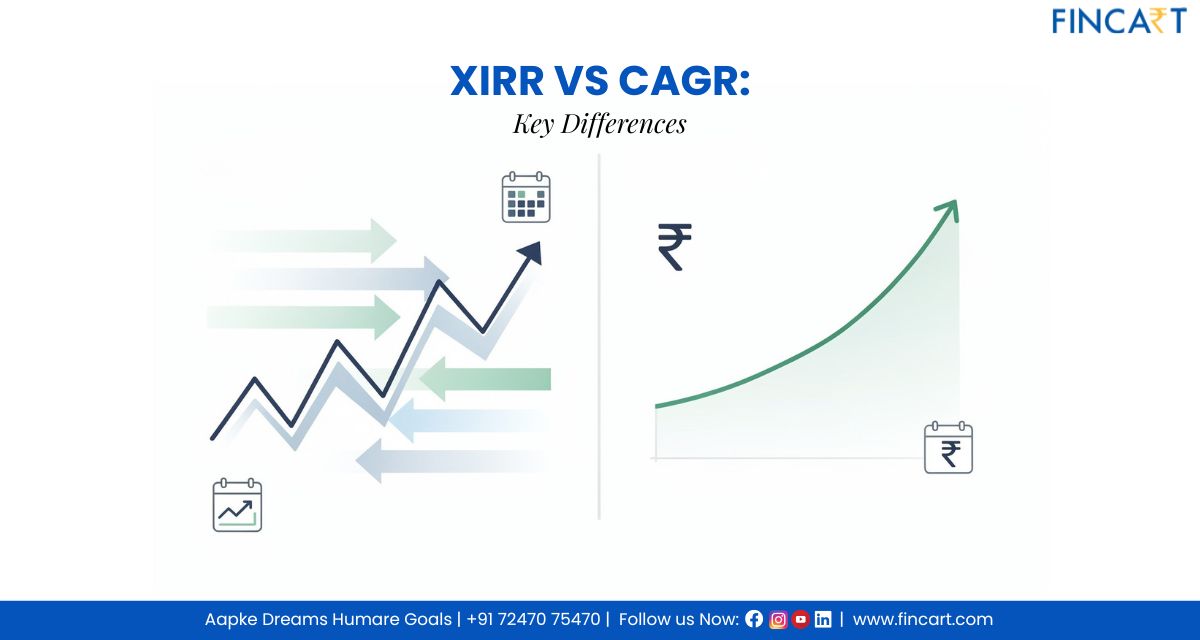
When investors evaluate the performance of their investments, the first question they usually ask is simple: How much did my money grow? The answer, however, depends heavily on how returns are measured. Two metrics, CAGR and XIRR, are commonly used to express investment returns, yet they serve very different purposes. This distinction often gets overlooked, leading to confusion and, in some cases, incorrect investment decisions.
Understanding the differences between CAGR vs XIRR is essential for anyone investing in mutual funds, especially when investments are made periodically rather than as a one-time lump sum. While both metrics express annualised returns, they are built on different assumptions and are suitable for different investment scenarios. This article explains those differences in detail, supported by a practical example, so investors can interpret their portfolio performance with clarity and confidence.
Understanding CAGR: What It Measures and What It Assumes
CAGR, or Compound Annual Growth Rate, represents the average annual growth rate of an investment over a specified period, assuming the investment grows at a steady rate year after year. It answers a theoretical question: At what constant annual rate would my investment have grown to reach its current value?
Key characteristics of CAGR include:
- It assumes a single initial investment
- It assumes no intermediate cash flows
- It smoothens returns over time, ignoring interim volatility
- It works best for lump sum investments
For example, if an investor puts ₹1,00,000 into a mutual fund and the value becomes ₹2,00,000 after five years, CAGR calculates the annual growth rate that would convert ₹1,00,000 into ₹2,00,000 over that period. It does not account for how the investment behaved during those five years; it focuses only on the starting and ending values.
This simplicity makes CAGR an attractive metric. It allows investors to compare different investments quickly and communicate performance in a standardized way. However, this same simplicity becomes a limitation when investments do not follow a single, uninterrupted path.
The Practical Limitations of CAGR
While CAGR is mathematically elegant, it rarely reflects how investors behave in real life. Most investors do not invest once and wait silently for years. Instead, they invest gradually, adjust contributions, pause investments, or withdraw money based on changing financial circumstances.
CAGR fails to capture these realities because:
- It ignores multiple investments made at different points in time
- It does not consider partial withdrawals or redemptions
- It treats the entire investment as if it were deployed on day one
- It can significantly misrepresent performance for SIP-based investments
For instance, when investors review the returns of a systematic investment plan (SIP) using CAGR, the result can be misleading. CAGR assumes that the entire invested amount was exposed to the market for the full duration, which is factually incorrect in an SIP structure where investments are staggered over time.
This is where the discussion around CAGR vs XIRR becomes critical. CAGR may still appear in fact sheets and marketing materials, but it is not always the most appropriate metric for evaluating investor-level returns.
What Is XIRR and Why It Matters
XIRR, or Extended Internal Rate of Return, is designed to address the shortcomings of CAGR. It calculates the annualised return of investments that involve multiple cash flows occurring at different dates. Instead of assuming a single starting point, XIRR considers the timing and amount of every investment and withdrawal.
In practical terms, XIRR answers a more realistic question: Given when and how much money I invested, what annual return did I actually earn?
XIRR is particularly relevant because:
- It accounts for each cash flow individually
- It reflects the time value of money
- It provides a more accurate measure of investor experience
- It aligns closely with how mutual fund portfolios operate
Because of these features, XIRR has become the preferred metric used by portfolio review tools, mutual fund statements, and professional advisory reports.
CAGR vs XIRR: Conceptual Comparison
The differences between CAGR vs XIRR become clearer when viewed side by side, particularly in the context of real-world investing.
| Basis of Comparison | CAGR | XIRR |
| Nature of investment | Suitable for one-time or lump sum investments | Suitable for multiple and irregular investments |
| Treatment of time | Assumes the entire investment is made at the beginning of the period | Considers the exact date of each investment and withdrawal |
| Realism of returns | Presents a smooth, averaged growth rate | Reflects the actual investment journey experienced by the investor |
| Accuracy for SIPs | Can misrepresent returns for SIP-based investments | Provides a realistic and accurate return for SIPs |
This comparison highlights why financial professionals increasingly emphasise XIRR in performance reviews. The debate around CAGR vs XIRR is not about which metric is superior in absolute terms, but about which metric is appropriate for the investment structure being analysed.
Step-by-Step Example: CAGR vs XIRR in Practice
Consider an investor who starts a monthly SIP of ₹10,000 in an equity mutual fund and continues it for three years. Over this period:
- Total investment: ₹3,60,000
- Number of instalments: 36
- Final portfolio value: ₹4,80,000
At first glance, the investment appears to have performed well. The key question, however, is how this performance should be measured.
Calculating Returns Using CAGR
CAGR formula, in general, is given by:
CAGR = (Ending Value ÷ Beginning Value)^(1 ÷ Number of Years) − 1
If CAGR is applied to the above SIP investment, it implicitly assumes that the entire ₹3,60,000 was invested on day one, which is not how SIPs work. Still, let us see what CAGR would come out to be.
Beginning Value = ₹3,60,000
Ending Value = ₹4,80,000
Time period = 3 years
CAGR = (4,80,000 ÷ 3,60,000)^(1 ÷ 3) − 1
CAGR = (1.3333)^(0.3333) − 1
Compound Annual Growth Rate ≈ 0.1006 or 10.06% per annum
A CAGR of approximately 10.06% suggests that the investment grew at a steady annual rate of just over 10%.
However, this interpretation is misleading because:
- The full ₹3,60,000 was not invested for the entire three years
- Most SIP instalments were invested much later and had less time to compound
- CAGR overstates the capital exposure to the market
This is the fundamental limitation of CAGR in SIP-based investments and a key reason why the CAGR vs XIRR distinction matters.
Calculating Returns Using XIRR
XIRR addresses this limitation by recognising that each SIP instalment is a separate cash flow, invested on a different date.
Conceptually, XIRR solves the following equation:
Σ [ Cash Flow ÷ (1 + r)^(Time in Years) ] = 0
Where:
Each SIP instalment of ₹10,000 is treated as a negative cash flow
The final portfolio value of ₹4,80,000 is treated as a positive cash flow
“Time” represents the exact gap (in years) between each cash flow and the final date
“r” is the XIRR
Each ₹10,000 investment remains in the market for a different length of time:
- The first SIP remains invested for almost 3 years
- The last SIP remains invested for only a few days or weeks
XIRR assigns appropriate weights to each of these cash flows based on time.
Using Excel or any standard portfolio tool, the XIRR function is calculated as:
XIRR = XIRR(cash flows, corresponding dates)
Result:
XIRR ≈ 14.5%–15.0% per annum (approximate, depending on exact dates)
Why CAGR and XIRR Give Very Different Results
| Metric | Return Shown | Why |
| CAGR | ~10.06% | Assumes full capital invested from day one |
| XIRR | ~14.5–15.0% | Accounts for staggered investments and timing |
The higher XIRR does not mean the investment suddenly became better. It simply reflects the true annualised return on the capital that was actually deployed at different points in time.
This numerical difference clearly demonstrates why CAGR vs XIRR comparisons are not just technical distinctions. They materially change how investors evaluate performance and judge whether an investment strategy has met its objectives.
Key Takeaway
CAGR answers: “What constant return would convert one lump sum into the final value?”
XIRR answers: “Given when I invested my money, what return did I actually earn?”
For SIP-based mutual fund investing, XIRR provides a far more realistic and meaningful measure of performance, which is why it is the preferred metric used by any mutual fund advisor or mutual fund consultant during portfolio reviews.
Common Misconceptions Around CAGR and XIRR
Despite their widespread use, both metrics are often misunderstood.
- One common misconception is that a higher XIRR automatically implies better performance. In reality, XIRR is sensitive to timing. Investing larger amounts closer to market peaks or troughs can significantly influence the final number.
- Another misconception is that CAGR is “wrong” or outdated. CAGR is not flawed; it is simply limited. It performs well within its defined scope but should not be forced onto scenarios it was not designed to measure.
- Some investors also believe XIRR is too complex or only meant for experts. In practice, modern portfolio platforms calculate XIRR automatically, and investors only need to understand what it represents, not how it is computed.
Clarifying these misunderstandings is central to any meaningful discussion on CAGR vs XIRR.
How Portfolio Reviews Use XIRR in Practice
In real-world investing, portfolio performance must reflect actual cash flows. Since most portfolios involve staggered investments and intermittent redemptions, return evaluation requires a metric that accounts for timing.
In portfolio reviews, a mutual fund advisor can use XIRR to highlight:
- The effectiveness of disciplined, periodic investing over long horizons
- The impact of investment timing on overall portfolio returns
- The benefits of remaining invested through periods of market volatility
From an evaluation standpoint:
- Portfolios with the same ending values may show materially different XIRRs
- These differences often arise from behaviour and timing, not just fund selection
Final Thoughts: Interpreting Returns Correctly
Investment returns are not just numbers; they are narratives of how capital was deployed over time. CAGR tells a simplified story of growth under ideal conditions, while XIRR tells the real story of how an investor’s money actually worked.
For lump sum investments, CAGR remains a useful benchmark. For periodic investments and long-term wealth creation through SIPs, XIRR provides a more accurate and meaningful assessment. Recognising the difference between CAGR vs XIRR enables investors to evaluate performance realistically, communicate effectively with advisors, and make better-informed financial decisions.
Ultimately, understanding return metrics is not about choosing one formula over another, but about choosing the right lens through which to view one’s investment journey.
Frequently Asked Questions (FAQs)
Q: Why does my XIRR change even when markets are flat?
A: XIRR changes because it factors in new investments and their timing. Even without market movement, cash flow changes can alter the annualised return.
Q: Can XIRR be negative even if the portfolio value is higher than total investment?
A: Yes. If large investments were made shortly before a market decline, the portfolio value may exceed total invested capital but still produce a negative or low XIRR due to limited time for those investments to recover.
Q: Is XIRR suitable for comparing different mutual funds?
A: XIRR is suitable for comparing investor-level outcomes, not fund-level performance. Two investors in the same fund may have different XIRRs depending on when and how they invested. For fund comparisons, standardised CAGR figures may still be more appropriate.
Q: Can XIRR be used to evaluate portfolio rebalancing decisions?
A: Yes. XIRR can help assess whether changes in allocation or rebalancing improved return efficiency over time.
Q: Do mutual fund statements always show XIRR?
A: Most modern statements and online platforms display XIRR for SIPs.
Q: Should investors track both CAGR vs XIRR?
A: Tracking both can be useful, but XIRR can be the primary metric for personal portfolio evaluation when investments are staggered.